


A primary operational failure in scaling enterprises is mistiming the structural engagement model of new hires. Founders and HR leaders frequently default to permanent headcount for project-based demands or rely on loose contractor agreements for core operational roles, creating unnecessary financial leakage and legal exposure.
Understanding when to deploy outsourced/contract workers versus permanent placements requires analyzing cash flow, operational velocity, and compliance risk under Indonesian labor law.
Comparative Decision Matrix
| Dimension | Outsourced / Contract Placement (PKWT) | Permanent Placement (PKWTT) |
|---|---|---|
| Primary Intent | Specialized short-term execution, project scaling, trial periods | Core company IP creation, long-term leadership, strategic roles |
| Capital Outlay | Variable operational expense (OpEx); predictable monthly billing | Fixed capital commitment (CapEx/Salary); long-term liability |
| Termination Risk | Pre-defined contract end dates; minimal severance exposure | Statutory severance pay (UPHK), long-service pay, and compensation |
| Speed to Deploy | Immediate (<14 days via pre-vetted agency pools) | Longer hiring cycles (30–90 days including notice periods) |
| Regulatory Risk | Managed via agency dual-entity compliance structure | Direct employer liability under Indonesian Labor Law (UU Ketenagakerjaan) |
Cash Flow & Financial Engineering
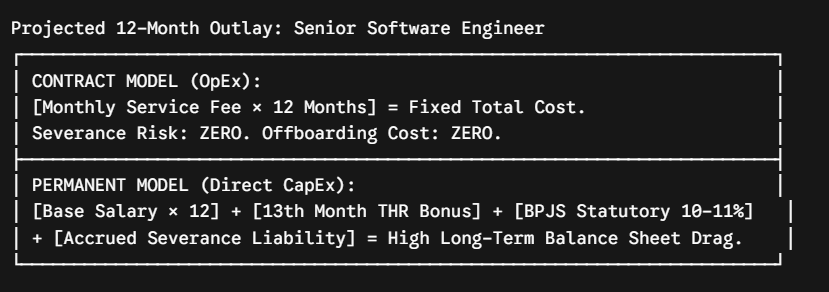
1. Contract / Outsourced Model: The OpEx Advantage
When hiring contract workers through a talent partner like Nusantara Talent Connector, workforce expenses are categorized as operational expenditure (OpEx).
- Cash Flow Flexibility: Companies pay a predictable monthly rate that covers base pay, management fees, and statutory contributions.
- Capital Conservation: Cash reserves remain intact without committing to long-term statutory severance reserves (UPHK), which under Indonesian law can equal up to 18+ months of salary for senior personnel upon termination.
- Project Elasticity: If market conditions shift or a project finishes, workforce costs scale down without incurring severance payouts or lengthy labor court disputes (PHI).
2. Permanent Placement: The Core Equity Model
Permanent roles (PKWTT) are appropriate when hiring core decision-makers, proprietary system architects, or executives whose long-term alignment directly impacts enterprise value.
While direct permanent hiring incurs upfront placement fees and long-term balance sheet liabilities, it yields higher ROI for foundational leadership roles where institutional knowledge retention is paramount.
Risk Assessment Framework: When to Choose Which
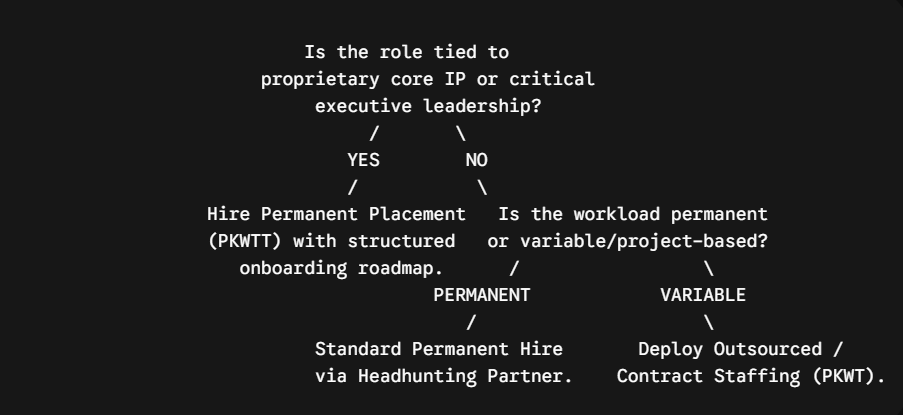
Strategic Hiring Rules:
- Deploy Contract / Outsourced Staffing when:
- You are building a new product line or launching an experimental marketing campaign with an unproven runway.
- You require specialized technical skills (e.g., Go Developer, DevOps) for an 8-to-12-month build cycle.
- You need rapid operational volume (e.g., logistics, customer support, data processing) without adding permanent administrative burden.
- Deploy Permanent Placement when:
- The role holds key budget ownership, direct management of core teams, or strategic direction (e.g., Head of Engineering, Finance Director).
- Key business outcomes require multi-year institutional retention.
Optimize Your Workforce Structure Today
Not sure whether your next key hire should be permanent or contract? Nusantara Talent Connector provides flexible staffing models tailored to your cash flow, matching pre-vetted professionals in under 14 days.